January: Champagne Explained

As we usher in 2026, let’s raise a glass to Champagne as the preeminent sparkling beverage it continues to be. Champagne signifies not only celebration but elegance. Wine fit for royalty, and wine fit for celebrating a new year.
Here’s a mini guide to help you pick the right bottle for all your January celebrations. Thank you to our subscribers for submitting these questions.
How do I know if my Champagne is dry or sweet?
This can be tricky to decode! Look for one of the following key terms on the bottle. Here’s the sweetness scale from dry to sweet:
Brut Nature: no sugar added; completely dry
Extra Brut: 3-6g/L of sugar, still tastes very dry
Brut: 6-12 g/L, still considered dry, but rounder on the palate
Extra Dry: 12-17 g/L, you can start to perceive sweetness
Dry: 17-32g/L, more noticeable sweetness
Demi-Sec: 32-50g/L, sweetness is definitely perceptible
What do you call sparkling wine made in the traditional method (Champagne method) outside of the Champagne region of France?
An excellent question. Have you ever seen the term Crémant on a wine list or bottle? This signifies a French sparkling wine made in the “Champagne method” (traditional method) but outside of the Champagne region. To clarify, traditional method sparkling wine means the second fermentation (the one that traps the bubbles) is completed inside the bottle. Crémant is delicious and generally costs less than Champagne. You can find it in a number of regions in France and they are absolutely worth seeking out. Here are a few: Crémant de Alsace, Crémant de Bourgogne, Crémant de Jura, and Crémant de Bordeaux.
And what do we call sparkling wine made in the traditional method outside of France? It depends. One safe catch-all term is “traditional method sparkling wine.” In Spain, traditional-method-bubbles are called Cava. In Italy, you’ll find Prosecco; however, Prosecco gets its bubbles via a secondary fermentation in a tank rather than in the bottle; this is why we don’t get pastry/biscuity notes on a Prosecco.
Are there quality tiers for Champagne?
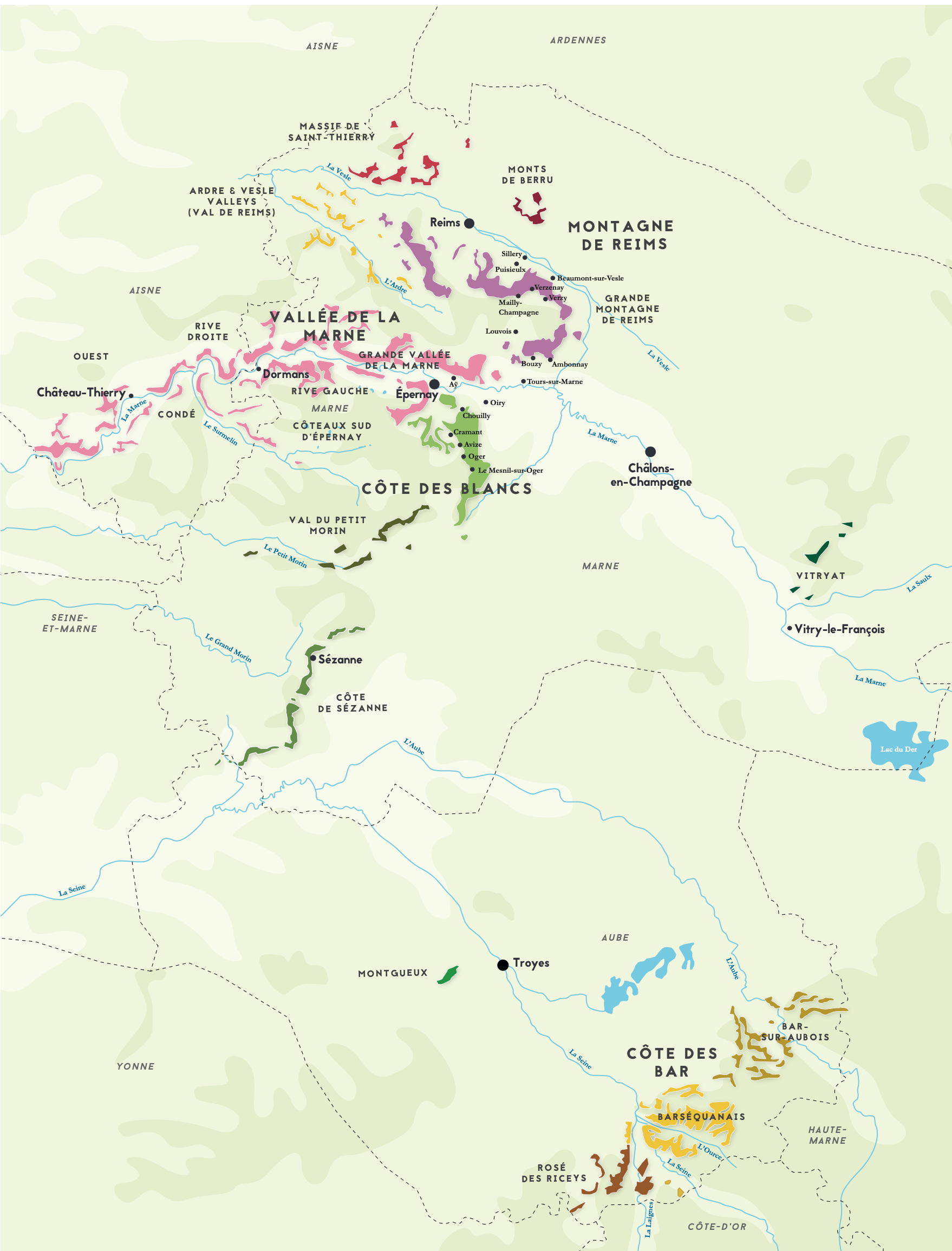
Yes! First, a fun fact: there are 319 villages in Champagne. Much like the system in Burgundy, you can find village level Champagne, Premier Cru Champagne, and Grand Cru Champagne.
One year ago, I was stacks-of-notecards-deep in my French Wine Scholar Test preparation when I memorized this fact: there are 17 villages in the Champagne region that have been recognized with Grand Cru status.
I will clarify that Grand Cru status does not signify a top producer in Champagne, but rather an entire village; there can be considerable variation among producers within these esteemed sites. Still, as there are only 17 of these prestigious villages, it’s fun to seek out a “Grand Cru” bottle for a special occasion (or Tuesday night, as you wish).
Here’s a Grand Cru Champagne worth seeking out: Barnaut Grand Cru Grande Reserve Brut ($43) from the Grand Cru Village of Bouzy. Fun fact: the main varietal here is Pinot Noir. This bottle is a steal! Not only is it from a Grand Cru Village, it’s also a grower Champagne (see below) made by winemaker Philippe Secondé. I was thrilled with this price point and plan to stock up so I can enjoy this bottle all month long (Drinking Grand Cru Champagne is a lovely alternative to Dry January, if you need one).
If your wine store doesn’t carry this bottle, ask for a special bottle of Champagne from a “Grand Cru village” and see where they lead you. Check out the bonus section for a list of all 17 Grand Cru villages.
I keep hearing about grower Champagne. What does this mean?
A grower Champagne means the Champagne house produces wines with grapes grown on site. They are special because the producer is involved in every part of the process from vine to glass. Many of the big (and famous) Champagne houses source grapes from all over the region; a grower Champagne uses grapes from their own site, offering a definitive signature of their terroir. To find a grower Champagne, look for this key term on the bottle: RM or Récoltant-Manipulant.
Why can’t I find the vintage year on my bottle of Champagne?
If you don’t see a vintage year on your bottle, you’re drinking “non-vintage” or NV Champagne. This means the producer is blending wine made from grapes that come from multiple sites and multiple years! Why? Historically, Champagne has had a marginal climate; it’s quite cold and humid in this northern region of France. In order to create a successful product, producers need the freedom to blend from multiple sites and multiple years to create their signature style. When you do come across a vintage on a bottle of Champagne, this signifies a special year that the producer wants to highlight, often at a higher price point.
What food should I pair with Champagne?
As far as pairing with food, you truly have carte blanche. One of the tips for the food pairing exercise in the WSET Level 1 class I teach is this: “when all else fails, go with Champagne”. Its high acid and effervescence complement everything. Champagne is brilliant with potato chips and caviar, the cheese course, and also with dessert. More important, in my opinion, is who you are sharing your Champagne with! May they be worthy of the regal bottle you share as you toast to new beginnings in 2026.
Are there any other bottles I should seek out from Champagne?
Everything we have covered so far has been in reference to sparkling wine from the Champagne AOC, but there are actually two other appellations in this region, and they are both dedicated to still wine!
Rosé of Pinot Noir from Champagne?! Yes! The Rosé des Riceys AOC (in the Cotes de Bar) is entirely dedicated to Rosé of Pinot Noir. I plan to search the Rosé aisles up and down in search of this tiny appellation. I also plan to ask Boulder Wine Merchant to order some for me if I can’t find any. (Production is only 60,000 bottles per year; largely these bottles are sold and consumed in France).
Coteaux Champenois AOC covers most of the same area as the entire Champagne AOC, and includes still wines from Chardonnay, Pinot Noir and Pinot Meunier.
Bonus Material: The 17 Grand Cru Villages in the Champagne AOC
The 17 Grand Crus villages come from three different subregions in Champagne. I’ll categorize them here as well as which varietal will be dominant in the blend. (A reminder that the three key varietals in Champagne are Chardonnay, Pinot Noir and Pinot Meunier).
Côte des Blancs. Here, Chardonnay is the most important varietal in the blend. There are six Grand Cru Villages: Avize, Cramant, Le Mesnil-sur-Oger (aka Mesnil), Oger, Oiry, and Chouilly.
Montagne de Reims. The most important varietal in the blend here is Pinot Noir. There are eleven Grand Cru Villages here: Ambonnay, Beaumont-sur-Vesle, Bouzy, Mailly-Champagne, Oger, Oiry, Puisieux, Sillery, Verzenay, Verzy, and Chouilly (also called Louvois).
Vallée de la Marne. Here, the most important varietal is Pinot Meunier. There are two Grand Cru Villages: Ay and Tours-sur-Marne.
This post is the first in my series Your Wine Calendar for 2026. Next stop: February: Corsica — French Wine with an Italian Secret.
Images courtesy of the Wine Scholar Guild.
Nice article!